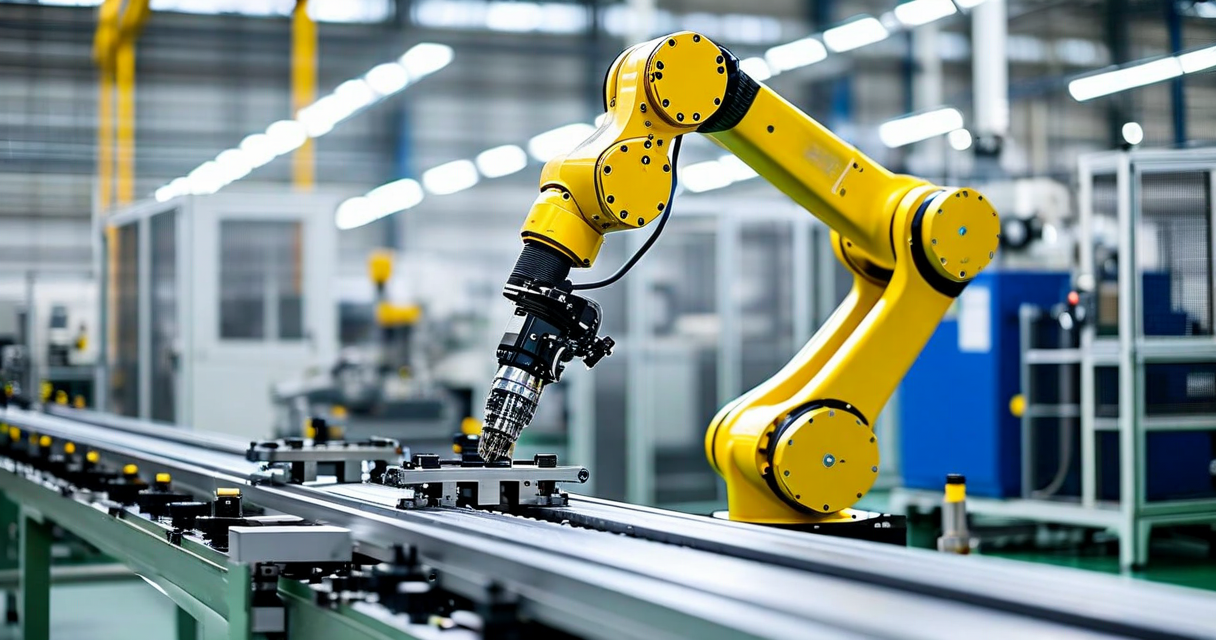
For most of industrial history, the automation of manufacturing was a game available only to the largest players. Traditional industrial robots — the kind that populate automotive assembly lines — required extensive engineering expertise to program, expensive safety caging to operate safely alongside humans, and production volumes high enough to justify the capital investment. Small and mid-size manufacturers, which constitute the majority of manufacturing employment in most developed economies, were priced out of automation and left to compete on the basis of skilled labor and management efficiency.
The emergence of collaborative robots — cobots — has changed this calculus fundamentally. Cobots are robot arms designed from the ground up to operate safely in proximity to human workers, to be programmed by non-specialists, and to be redeployed to new tasks without extensive engineering effort. The cobot market has grown from a niche category to a major segment of the industrial robot market in less than a decade, and at Gravis Robotics Capital, we believe the growth trajectory is still in its early innings.
What Makes a Cobot Different
The defining characteristic of a collaborative robot is not its physical form factor — most cobots look like scaled-down versions of traditional industrial robot arms — but its fundamental design philosophy around human collaboration. Traditional industrial robots are fast, powerful, and precise, but they are also dangerous to humans who enter their operational envelope. They are typically deployed behind physical barriers, separated from human workers by cages, light curtains, and interlocked doors.
Cobots are engineered differently. They operate at lower speeds and forces. They are equipped with force-torque sensors in their joints that can detect contact with a human body and immediately stop to prevent injury. They are designed to be lightweight and small enough to be safely handled by a single worker during setup and redeployment. And they are programmed through intuitive interfaces — often by physically guiding the robot arm through the desired motion sequence rather than writing complex code — that put automation within reach of workers without engineering backgrounds.
These differences translate directly into the economics of deployment. A traditional industrial robot system, including the arm, end effector, safety infrastructure, and engineering for programming and integration, might cost $200,000 to $500,000 to deploy for a specific manufacturing task. A cobot system for a comparable task might cost $30,000 to $80,000 all-in, can be deployed in days rather than months, and can be reprogrammed for a new task in hours when production requirements change. This order-of-magnitude difference in deployment economics opens the market for automation to manufacturers who were previously excluded.
The Small and Mid-Size Manufacturer Opportunity
Small and mid-size manufacturers — typically defined as those with 20 to 500 employees — represent the most important untapped market for robotic automation. There are hundreds of thousands of these manufacturers in the United States and Europe alone, and the vast majority have minimal automation beyond basic conveyor systems and fixed-function machinery. They compete against lower-wage overseas manufacturers on the basis of proximity, quality, and responsiveness — advantages that become more sustainable when amplified by automation.
The challenges these manufacturers face are well-understood. They struggle to recruit and retain skilled labor for repetitive, ergonomically demanding tasks. Quality consistency is difficult to maintain across a workforce with varying levels of experience and skill. And their production volumes and product variety often do not justify the capital investment and engineering complexity of traditional automation.
Cobots address all three challenges directly. A cobot performing a repetitive assembly or inspection task does so with perfect consistency, 24 hours a day if needed, without fatigue or quality variation. Human workers are freed from ergonomically damaging repetitive motions and can be redeployed to higher-skill, higher-value activities that require judgment and dexterity that cobots cannot yet match. And the low deployment cost and reprogrammability of cobots make them accessible to manufacturers whose production volumes and product variety previously ruled out automation.
The Application Landscape
The range of applications where cobots are demonstrably delivering value has expanded significantly as the technology has matured. Machine tending — loading and unloading CNC machines, injection molding machines, and other automated equipment — is the largest single application category and one where the ROI case is particularly compelling. A cobot that tends a CNC machine 24 hours a day, replacing overnight manual loading or machine downtime, can deliver payback in under a year in many production environments.
Assembly operations represent another major category. Cobots are well-suited to assembly tasks that require consistent force application, precise positioning, and repetitive motion — fastener insertion, adhesive application, press-fit assembly — where human workers develop repetitive strain injuries over time and where quality varies with worker fatigue and experience level. The combination of human judgment for complex sub-assembly and cobot assistance for the repetitive elements of an assembly task is emerging as a highly efficient production model.
Quality inspection and measurement is a growing application area that plays to cobots' natural strengths. Equipped with vision systems and measurement tools, cobots can perform dimensional inspection, surface defect detection, and functional testing tasks that have historically relied on skilled human inspectors. The speed, consistency, and auditability of robotic inspection are compelling advantages for manufacturers operating in quality-critical industries like automotive components, aerospace parts, and medical devices.
Barriers to Adoption and How They Are Being Solved
Despite the compelling economics and growing application landscape, cobot adoption among small and mid-size manufacturers has been slower than the market opportunity would suggest. Understanding the real barriers to adoption is essential for investors and entrepreneurs trying to accelerate penetration of this market.
The most significant barrier is not capital cost — it is knowledge and confidence. Many small manufacturers lack the internal expertise to evaluate cobot solutions, identify appropriate applications, specify end effectors and peripheral equipment, and manage the integration and programming process. They are worried about buying technology they do not understand and getting poor results. This creates a strong market opportunity for companies that provide not just the robot hardware but a complete application solution — hardware, software, integration, and ongoing support — that reduces the knowledge burden on the customer.
The value-added reseller and systems integrator channel is critical in this market, and companies that invest in building a strong integration partner ecosystem grow faster than those that rely entirely on direct sales. The integrator has the trusted relationship with the customer, understands their specific application requirements, and can manage the implementation in a way that the robot manufacturer typically cannot cost-effectively do at scale.
A second barrier is workforce concern. Workers who operate in manufacturing environments sometimes perceive cobot deployments as a threat to their employment. Manufacturers who have navigated cobot deployments successfully are typically those who communicated clearly about the intention to redeploy workers to higher-value activities rather than eliminate positions, and who involved frontline workers in the application design process. Cobots that are perceived as tools that help workers rather than replace them are adopted more quickly and operated more effectively.
Investment Opportunities in the Cobot Ecosystem
The cobot market has a number of large, established hardware vendors, which might suggest limited opportunity for new entrants at the pure robot arm level. But the ecosystem around the robot hardware — applications software, end effectors, vision systems, integration tooling, and vertical market-specific solutions — remains a rich area for seed-stage investment.
We are particularly interested in companies building purpose-designed solutions for specific high-value cobot application categories: robotic welding for small job shops, electronic assembly for contract manufacturers, and laboratory automation for life science and pharmaceutical environments. In each of these niches, there is room for a company that brings deep application expertise and purpose-designed tooling to differentiate against the more general-purpose solutions offered by large hardware vendors.
Key Takeaways
- Cobots have democratized access to industrial automation for small and mid-size manufacturers who were previously priced out of the market.
- The economics of cobot deployment are compelling: lower upfront cost, faster installation, and easy reprogramming create ROI timelines under two years for many applications.
- Machine tending, assembly, and quality inspection are the leading applications driving current cobot adoption.
- The primary barrier to SME adoption is knowledge and confidence, not capital — solutions that reduce the implementation burden grow faster.
- The cobot ecosystem around hardware — applications software, end effectors, and vertical solutions — remains a rich area for seed-stage investment.
Conclusion
The collaborative robot has unlocked a market for manufacturing automation that previous generations of robot technology could not reach. The small and mid-size manufacturer segment is large, underserved, and increasingly motivated to invest in automation as labor costs rise and quality standards tighten. The companies building the solutions that make cobot automation accessible, productive, and trusted in this segment are building important and durable businesses. At Gravis Robotics Capital, this is a core area of investment focus, and our $44M Seed Round positions us to back the best companies in this space from their earliest stages. Talk to us if you are working in this area.